
The peacock, famed for its brilliant feather display, holds symbolic significance across cultures, often representing power, strength, and even divinity. In its native India, where it serves as the national bird, the peacock signifies the flow of time.
Hindu mythology describes the peacock as created from a feather of Garuda, an eagle-like deity and companion of Vishnu, a principal Hindu god.
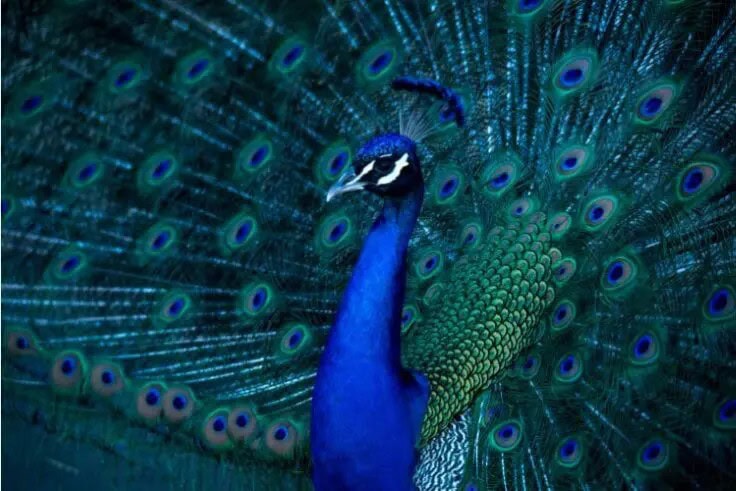
Other cultures also revere the peacock: Yazidis consider it a divine manifestation, while in Greek mythology, it’s linked to royalty through the goddess Hera. The Romans viewed it as a symbol of immortality, and it even appeared in early Christian art.
While peacocks captivate us with their beauty, their showy feathers serve a vital biological purpose linked to mating. Male and female peafowls, often collectively called “peacocks,” display notable differences in appearance, with the more familiar Indian species standing out.

The Indian peacock flaunts an iridescent blue-green plumage, while the more understated peahen has brown, scalloped feathers. Their relative, the green peafowl of Southeast Asia, displays a similar elegance in both sexes, yet only the male grows a long, ornamented train.
The Congo peafowl of Africa, the only peafowl species outside Asia, lacks this elaborate train but has a distinctive, shimmering greenback.
Peacock Plumage: Evolutionary Theories
Theories on the evolution of peacock plumage suggest its role in sexual selection. In peafowls and other birds, males are often more vibrantly colored to attract mates. According to Darwin’s theory of sexual selection, features like the peacock’s train give certain males an advantage in the mating game.

Females, or peahens, tend to prefer males with highly ornamented trains, leading to more offspring with these traits, making elaborate displays a competitive asset for future generations.
Research from the 1980s involving a feral peacock population in England supports this preference, showing that peahens often choose males with more intricate trains.
The Role of Ornamentation in Mating
Some researchers argue that elaborate plumage signals genetic quality, indicating traits such as health, vitality, and resilience. Studies reveal that peacocks with more eyespots tend to produce healthier offspring with a higher chance of survival.
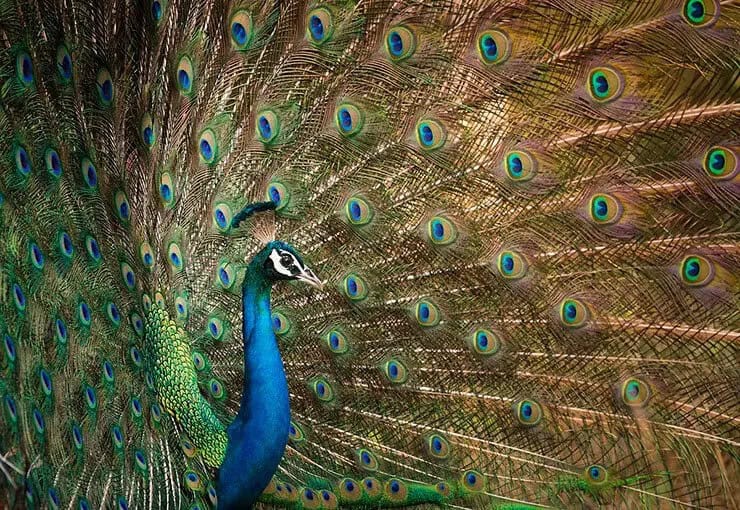
However, peahens may evaluate potential mates based on multiple factors, like symmetry, color contrast, and iridescence, rather than just train length.
Beyond mate attraction, peacocks also use their feathers defensively. A peacock’s loud call and eye-spotted train create an intimidating display against potential threats.
Peafowls are highly territorial and defend their space and mate aggressively, especially during breeding season.
The Peacock’s Display: Dance and Vibrations
Mating displays among peafowl occur during lekking ceremonies, where males compete for attention by spreading their plumes and creating vibrant, eye-catching performances. Peahens assess potential mates by observing the details of the display.
Once a male attracts a female’s interest, he uses low-frequency vibrations that she detects through her feathered crest. This behavior, undetectable to humans, adds another layer of allure to his display.
The Cost of Beauty and the Call for Conservation
While dazzling, the peacock’s train comes with costs. It can weigh down the bird, impacting its mobility and increasing predator vulnerability. According to the “handicap principle,” this burden signals the male’s fitness to survive despite the inconvenience, making him more attractive as a mate.
Nevertheless, studies suggest that female preferences may vary across environments, and mating success doesn’t always correlate with the most elaborate trains.
Admired worldwide, the peacock’s beauty has also made it a target for illegal hunting and poaching. India’s Wildlife Protection Act prohibits killing peafowl, and feather exports are banned.
Despite sustainable harvesting methods from shed feathers, animal rights groups seek stricter regulations to prevent exploitation.
The peacock’s extravagant display continues to captivate as scientists and admirers explore the mysteries behind its timeless allure.
Read More Birds