
The white bellbird (Procnias albus), native to Central and South America, is known for its astonishingly loud call, rivaling the noise of an aircraft taking off from 50 meters away.
With a song that can be heard from miles across Amazonian forests, this bird holds the title of the loudest bird species on Earth. Its booming call is used to attract mates, often delivered at full volume even when a potential partner is mere centimeters away.
Unique Features of the White Bellbird
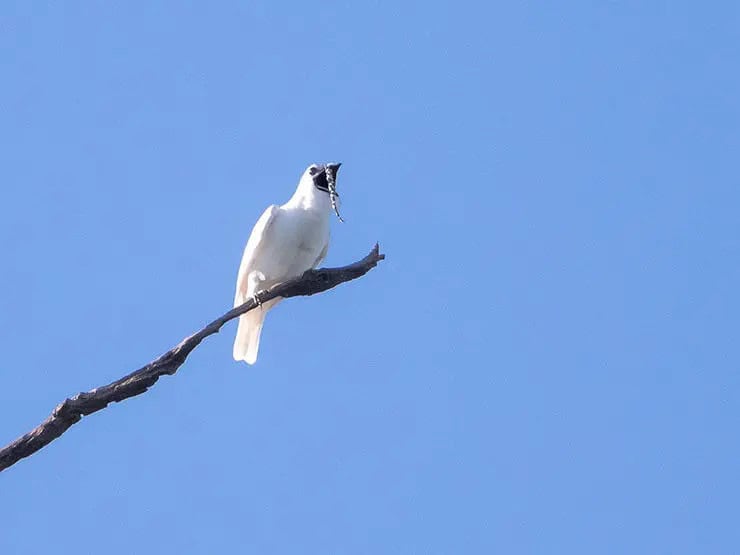
The white bellbird stands out more for its vocal power than its appearance. With a plain white body, a wide mouth, and a long, thin wattle hanging from the top of its beak, it’s relatively inconspicuous in the Amazon compared to its brightly colored neighbors.
Its song has a metallic, almost industrial sound, and when multiple bellbirds sing together, it can resemble the din of a noisy forge.

The bird’s unusually thick abdominal wall aids in producing its powerful song. Recent advances in sound-measuring technology have allowed researchers to study the white bellbird’s call more accurately.
With devices like decibel meters, researchers observed that the bird’s song includes two variations: a longer, more complex version and a shorter, simpler one that can reach an incredible 125 decibels.
For comparison, this is about three times louder than the scream of the piha bird, previously considered the loudest bird. The shorter, louder call demands more energy, which explains its simpler structure.

Courtship and Behavior
One of the white bellbird’s unique behaviors is its approach to courtship. Instead of quieting down when a female is close by, as most birds do, the male white bellbird turns to face her and continues to sing at full volume right in her direction.
This unusual behavior challenges typical bird courtship practices and could offer valuable insights into mating behaviors in the animal kingdom. More field observations will be needed to fully understand the role of this intense song in courtship.
Quick Facts
- Scientific name: Procnias albus
- Weight: ~250 g
- Length: ~28 cm
- Diet: Primarily fruit, which it often swallows whole
- Habitat: Prefers the canopies of subtropical and tropical humid forests, usually staying below altitudes of 1250 meters
- Main Threats: Habitat loss due to deforestation in the Amazon
Physical Characteristics
The male white bellbird is mostly white, with a black beak and a dark wattle that typically hangs on the right side of its beak. The female, however, has a more camouflaged greenish plumage with yellow on her underside, making her easy to mistake for other bellbird species like the bearded bellbird.
Habitat and Distribution
The white bellbird’s range spans across Venezuela, Guyana, Suriname, French Guiana, and parts of northern Brazil, with occasional sightings in the southeastern Amazon. Although they are rarely spotted in Trinidad and Tobago, sightings have been reported.
Diet and Feeding Habits
These birds favor the treetops, where they use their large beaks to consume whole fruits, later dispersing the seeds throughout the forest. Their role in seed dispersal contributes to the ecosystem’s health by promoting forest regeneration.
Breeding and Courtship Rituals
During courtship, the male white bellbird emits his loudest calls, reaching up to 125 decibels, to capture a female’s attention. While he sings, she often perches nearby, observing and assessing her suitor up close, even at the risk of auditory damage.
Conservation Status
While sightings are rare, the white bellbird population is considered large and widespread throughout the Amazon. Despite minor declines, it is not currently facing significant threats, and the species is classified as Least Concern on the IUCN Red List.
The white bellbird’s incredible volume and unusual courtship behavior make it a fascinating subject of study and a testament to the diversity of life in the Amazon rainforest.
Read More Birds