
Pure white and elegant, the little egret (Egretta garzetta) glides onto the shallow waters of swamps, showcasing its impressive wingspan of nearly a meter. Its slender neck and sharp, pointed beak make it a skilled hunter, ready to pierce and swallow its prey.
This small heron has a unique hunting trick: it sometimes hovers low over the water, spreading one wing to reduce reflections on the surface, allowing it to spot fish, amphibians, and other aquatic invertebrates more accurately.
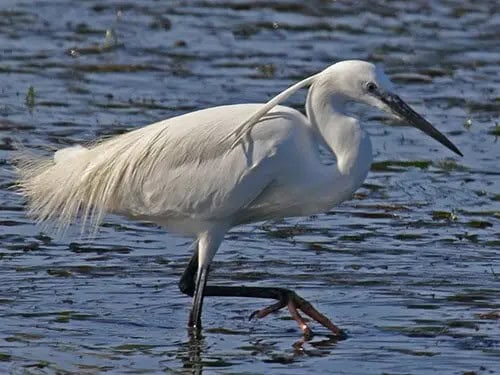
Native to the heron family, the little egret nests in parts of Europe, Asia, and northwest Africa, including the Cape Verde Islands, and has subspecies spread across the Philippines, Oceania, Russia, China, Madagascar, and surrounding islands.
With its graceful white feathers, the little egret blends into dense vegetation, where it stalks and swiftly captures its prey in nearby waters.
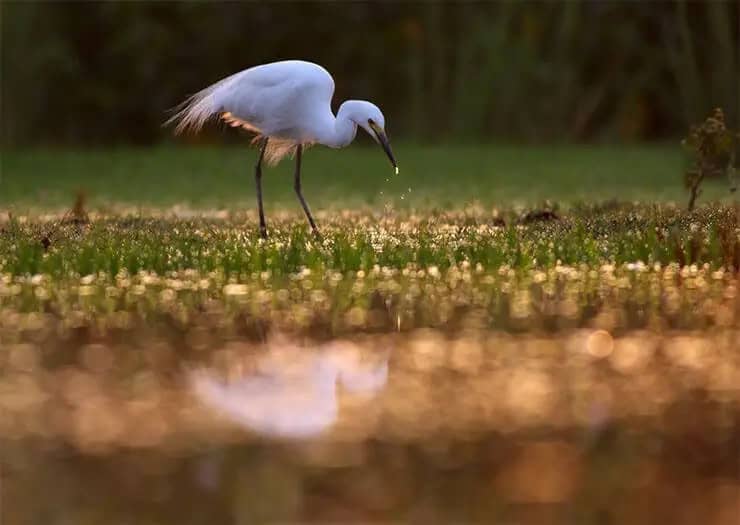
While solitary during feeding, multiple egrets can often be seen hunting together in areas with abundant food sources. They are highly recognizable due to their all-white plumage and tend to show little fear of humans.
Characteristics and Appearance
Both male and female little egrets have identical appearances with pure white feathers, black legs, and yellow feet. During the breeding season, adult egrets develop two long feathers on the back of the head, forming a distinctive tuft, and a slight purple color appears at the base of their beak.
Young egrets closely resemble adults, though some may have yellow-orange or purple tones on the lower part of their beaks.

Habitat and Range
Little egrets are strongly linked to water and are frequently found in marshes, ponds, rivers, and canals. They are common throughout southern Europe, the Mediterranean, Africa, South Asia, Australia, and Indonesia.
In Italy, some populations migrate seasonally, nesting in the Po River valley and wintering in Africa or migrating from central Europe to spend winters.
Diet and Hunting Behavior
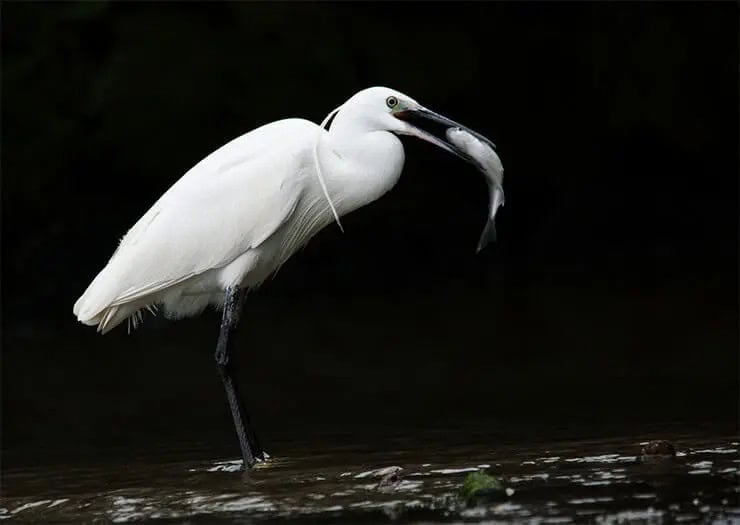
Their diet mainly includes fish, amphibians, reptiles, and invertebrates like mollusks, crustaceans, and insects. Little egrets forage in shallow waters, using their long, pointed beaks to capture prey. Often, they hunt in groups, striking their prey with precise beak movements before swallowing it.
Breeding and Nesting
Typically quiet, the little egret becomes more vocal during its breeding season. It nests in colonies, sometimes alongside other heron species, building large nests from dry twigs in tall trees or shrubs near marshy areas.
In April, the female lays three to five bluish-green eggs, which both parents incubate for around three weeks. Chicks leave the nest about 20–25 days after hatching and are ready to fly a few weeks later.
Conservation Status
The little egret is generally considered secure in Europe, where its population is estimated at 39,000 to 54,000 breeding pairs, accounting for a significant portion of the global population. The species prefers habitats like shallow lakes, ponds, lagoons, and slow rivers and sometimes inhabits rice fields or other flooded areas.

The density of little egret colonies depends on food availability and suitable nesting spots, with higher nest sites often leading to more successful broods.
Read More Birds