
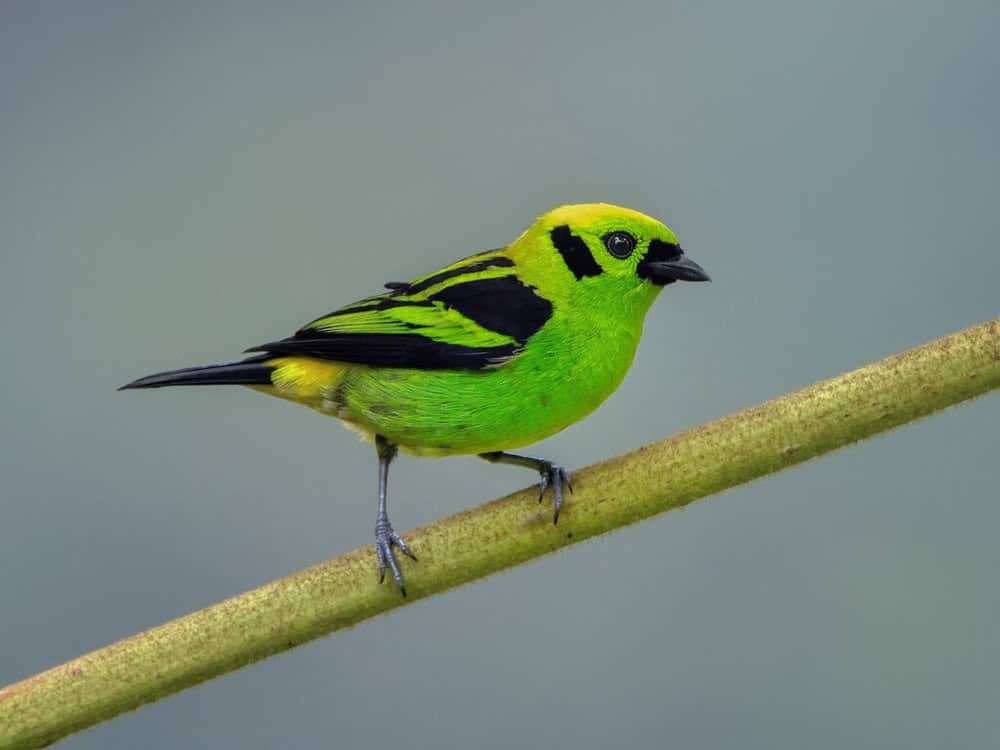
The emerald tanager is aptly named, with its vivid green feathers highlighted by golden and black accents. This stunning bird, scientifically known as Tangara florida, is characterized by its predominantly emerald-green plumage and distinct black trapezoidal cheek patch.
If you prefer not to read the full story,
Skip ahead to watch the video ->
Meet the Emerald Tanager:
Appearance: The emerald tanager displays light green feathers across its body with a black patch around the base of its bill, chin, and sides of its face. A dark yellow crown and rear section add vibrant contrast, while its upper back is black, transitioning into a darker yellow on the lower back, rump, and upper tail.

Its wings feature a mix of black and green tones, while the underparts are mostly light green with touches of light yellow on the belly and under the tail.
Male emerald tanagers also have brown eyes, a black bill, and bluish-gray feet. Females have a similar appearance, though with more subdued yellow-green hues on the head.
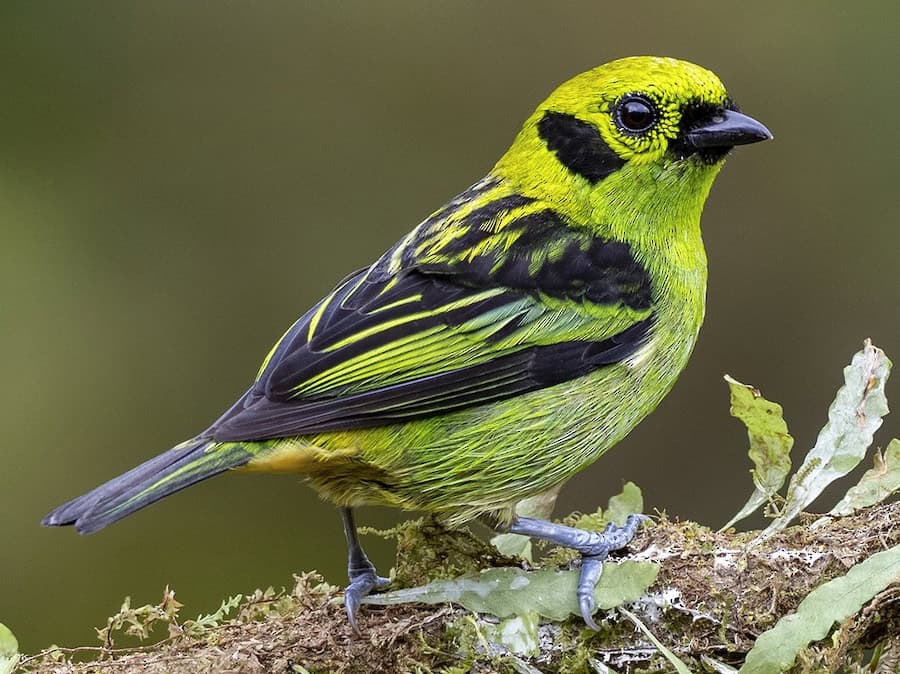
Distinctive Features: The emerald tanager’s coloring is less intense than similar species, such as the glistening-green tanager and blue-whiskered tanager, making it easier to identify by its unique coloration.
Habitat and Distribution: This species is native to the forests of Colombia, Costa Rica, Ecuador, and Panama. It inhabits humid lowland forests, montane evergreen forests, and secondary forests, preferring the canopy over the ground level.
Occasionally, it is spotted near fruit-bearing trees and shrubs, although it usually favors densely forested areas over open spaces.

Diet: The emerald tanager is omnivorous, mainly consuming fruit but supplementing its diet with arthropods, flowers, and buds.
During the breeding season in Costa Rica, arthropods become a larger part of its diet. Common fruits consumed include those from genera such as Miconia, Coussapoa, Cecropia, Ficus, Ilex, Tetrochidium, and Topobea.
Breeding: The breeding season varies across its range, from March to May in Costa Rica and January to April in Colombia.
The emerald tanager builds cup-shaped nests on moss-covered branches, typically positioned 1.5–12 meters (4.9–39.4 feet) above ground. Breeding pairs are observed bringing insects and fruit to the nests, which usually contain two eggs.
Vocalizations: The emerald tanager’s call is a sharp “chip” or “tsip” sound that can sometimes develop into a rapid twitter, and its song consists of loud “cheet” or “chirp” notes.
Conservation Status: Listed as “Least Concern” by the IUCN due to its wide range and stable population, the emerald tanager is nonetheless facing a gradual decline. Habitat destruction remains a primary threat, particularly in regions undergoing significant environmental changes. The population is estimated to be between 40,000 and 499,999 mature birds.
Read More Birds