
The Eurasian wigeon, a member of the Anatidae family, is known for its distinctive high-pitched whistling call, especially prominent during the male’s mating season.
Unlike diving ducks, this species belongs to the “surface duck” group, dipping only its head underwater to feed rather than submerging its entire body.
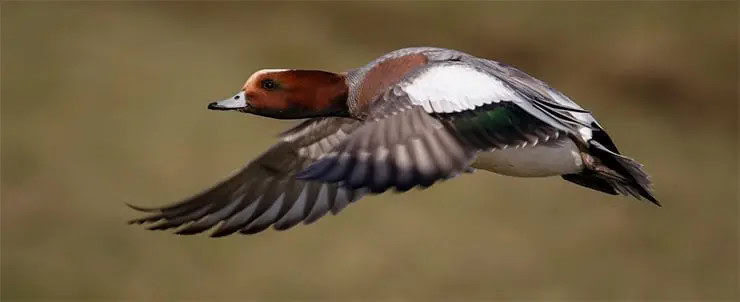
A migratory species, the Eurasian wigeon winters as far south as the Italian peninsula. Birds seen in Italy often originate from northwestern Europe, the British Isles, the Baltic, and regions around the Black and Caspian Seas, while Mediterranean-bound wigeons typically come from Spain.
In winter, these ducks favor lakes, estuaries, lagoons, and bays, while during breeding season, they nest near rivers, marshes, and meadows.

Quick Facts
- Scientific name: Mareca penelope
- Weight: 500–900 g
- Length: 45–51 cm
- Wingspan: 75–86 cm
- Lifespan: Up to 34 years
- Diet: Primarily plant-based, with occasional small invertebrates
- Habitat: Wetlands, agricultural zones, lakes, and waterways
- Threats: Avian flu, hunting
Appearance
The Eurasian wigeon is a colorful bird with distinct gender differences. The male’s breeding plumage includes a reddish-brown head, a pinkish chest, grey sides, and white underparts, contrasted by a black and white tail region.
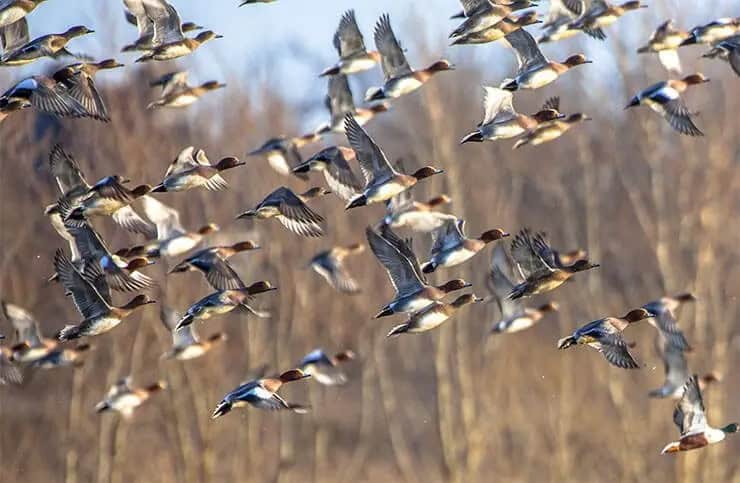
Females display warmer reddish-brown tones. Although similar to the American wigeon, the Eurasian wigeon’s red head and chest help set it apart.
Habitat and Distribution
Native to Europe and Asia, the Eurasian wigeon migrates seasonally, spending winters in the southern parts of its range and summers further north.
It prefers habitats like swamps, ponds, and wetlands with dense vegetation for breeding and open water bodies such as lakes and river mouths for wintering. They avoid heavily forested areas, choosing open spaces with access to water and vegetation for foraging.

Diet and Feeding
Primarily herbivorous, Eurasian wigeons feed on aquatic plants and algae but also eat small mollusks, insects, and crustaceans when available. They forage both on land and water, often grazing at dusk and hiding in vegetation by day.
Breeding Behavior
Eurasian wigeons are monogamous, with pairs remaining together for life. Their mating season aligns with spring, and females build nests on dry ground close to water, camouflaged within dense vegetation.
Each year, the female lays a single clutch of 7-8 cream-colored eggs, hatching in about four weeks. After hatching, the ducklings remain under the mother’s care for around two months until they become independent.

Conservation Status
Despite various threats, the Eurasian wigeon remains one of Europe’s most abundant duck species, with an estimated 70,000 to 120,000 breeding pairs in the European Union. Classified as “safe,” it faces limited conservation challenges; however, avian flu and hunting remain key threats.
Lead poisoning from ingesting hunting pellets is a common issue, as is habitat disruption from recreational activities in freshwater sites. Pollution in coastal wetlands from industrial activities also poses risks.
To protect this species, limiting hunting periods and preserving vital wintering habitats are essential steps. Conservation efforts focusing on reducing human impact in key habitats could further support Eurasian wigeon populations.

Read More Birds
