
The goldcrest, one of Europe’s smallest birds, is recognized as the “king of the birds” in folklore and belongs to the kinglet family, Regulidae. Native to Europe and Asia, this tiny bird has fourteen subspecies spread across Eurasia and the Macronesian Islands.
Quick Facts:
- Average Lifespan: 8 months (longest recorded: 7 years)
- Size: 3.5 inches (9.2 cm) in length, 5.7-inch (14.5 cm) wingspan
- Weight: 0.20 oz (5.8 g)
- Scientific Name: Regulus regulus
1. Appearance and Adaptations
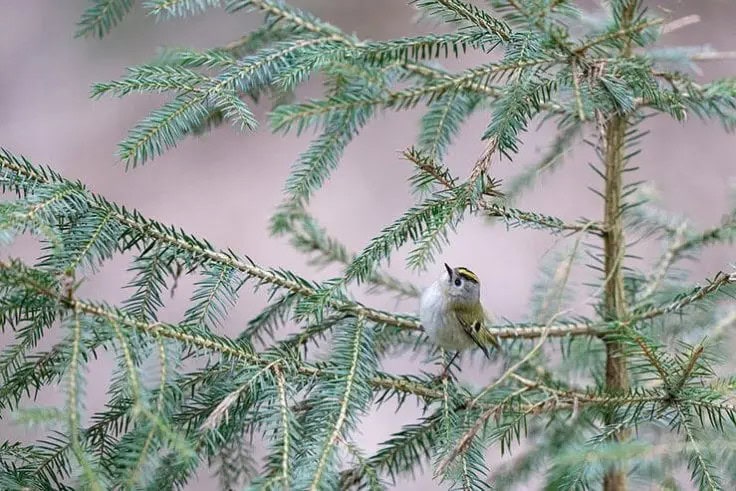
At just three inches long, the goldcrest is a plump, round bird with a yellow-green back and a pale buff belly. It has distinctive black and olive wings marked by white bands and a short, pointed bill.

The bird’s bright yellow crest, edged with black, is most prominent in males, who have a slight orange tint to their crests. This feature inspired both its common and scientific names—Regulus, meaning “king” in Latin.
The goldcrest’s legs and feet are small and brownish, with long hind toes suited for clinging to branches. Their rapid, whirring flight and erratic movements make it harder for predators to track them.

2. Name Origin and Folklore
The name “goldcrest” is inspired by the bird’s striking yellow crest. According to an old folktale, a contest to see which bird could fly the highest ended when a small bird, hidden in an eagle’s feathers, emerged and soared past the eagle, earning the title “king of the birds.” This bird is believed to be the goldcrest.
3. Songs and Calls
Goldcrests communicate with a high-pitched “zee zee zee” call. Males sing specific courtship and territorial songs, which are essential in distinguishing subspecies on the Macronesian Islands.
4. Behavior and Social Habits
Goldcrests are diurnal and highly active, often hovering and making sharp turns as they flutter around tree branches. In cold winters, they roost together to conserve heat, huddling in groups to stay warm rather than lowering their body temperature like some other small birds.

Migratory populations, particularly in the north and east, increase their body fat reserves before migrating south for the winter.
5. Range and Migration
The goldcrest is found from Iceland and the Macronesian Islands to the far eastern parts of Eurasia. Northern and eastern populations migrate south for winter, and these tiny birds can travel as far as 500 miles (800 km) in a single day.
6. Habitat Preferences
During the breeding season, goldcrests prefer coniferous forests, particularly trees like spruce, pine, and fir. Outside of this period, they expand into open heathlands, shrublands, and deciduous areas.
7. Diet and Feeding
Primarily insectivorous, goldcrests feed on small insects, spiders, and invertebrate eggs. During winter, they join mixed-species flocks and often forage on tree branches, where they may occasionally consume nectar or sap.
8. Reproduction
Goldcrests form monogamous pairs. Males court females by singing and raising their colorful crests. Nests are made from moss, twigs, and lichen, and built as triple-layered cups in coniferous trees.
Females lay between six and thirteen eggs, incubating them while males provide food. After about 19 days, the young fledge was cared for by both parents.

9. Predators and Threats
Common predators include Eurasian sparrowhawks, merlins, tawny owls, and long-eared owls. Fleas, lice, and mites are common pests for goldcrests, and their erratic flight may help them evade some predators.
10. Conservation Status
With an estimated population of 200 million, the goldcrest is classified as “least concern” by the IUCN. Despite high mortality during harsh winters, populations recover quickly, often expanding into new areas once conditions improve.
This resilient bird continues to thrive across a vast territory, embodying the spirit of survival in even the smallest of creatures.

Read More Birds
