
The garden emerald, a small yet stunning hummingbird, is a rare sight, typically appearing in second-growth forests, gardens, and along forest edges.
About the Garden Emerald
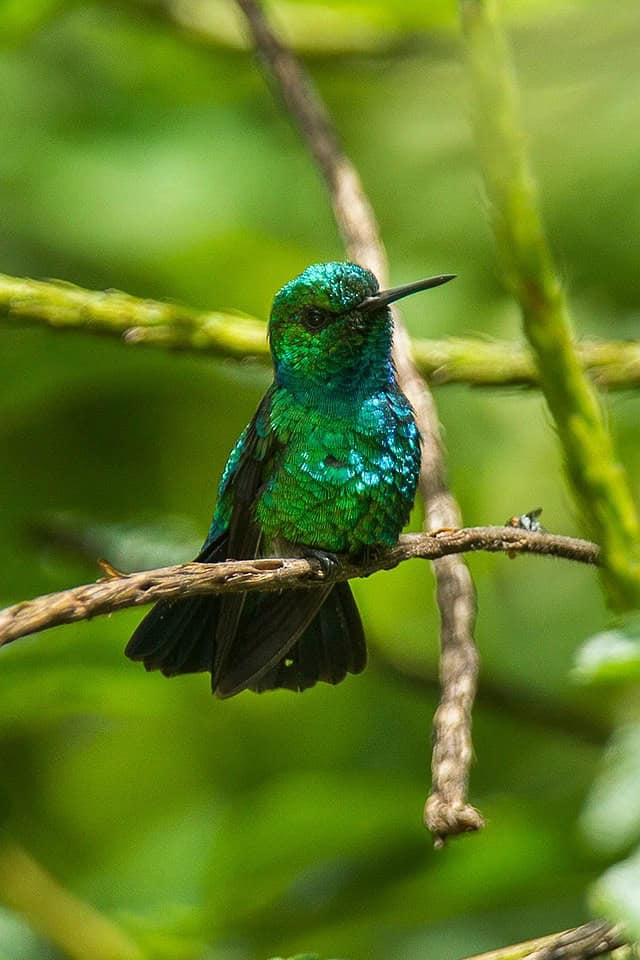
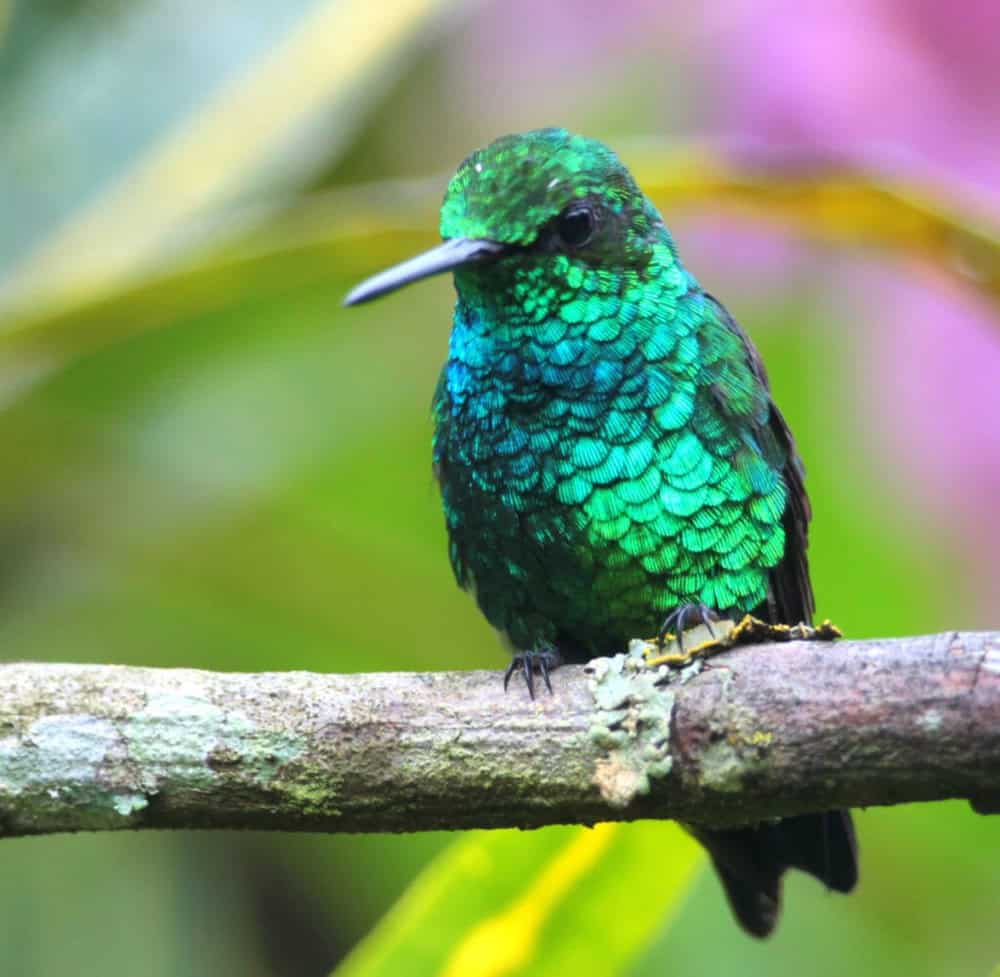
Appearance: The garden emerald measures 7.8 to 8.5 cm (3.1 to 3.3 in) long and weighs approximately 3 to 4.1 g (0.11 to 0.14 oz). Adult males showcase dark metallic green feathers with bluish-green tones on their uppertails.

Their forked tails have a striking blue-black shade with a faint blue-green gloss, while the underparts are bright metallic green, sometimes showing a light blue hint and white thigh tufts.
Females display bright green to bronze-green feathers on their upper parts, bluish-green uppertail feathers, and tails with a mix of blue-black and metallic green hues, finishing with pale gray tips.
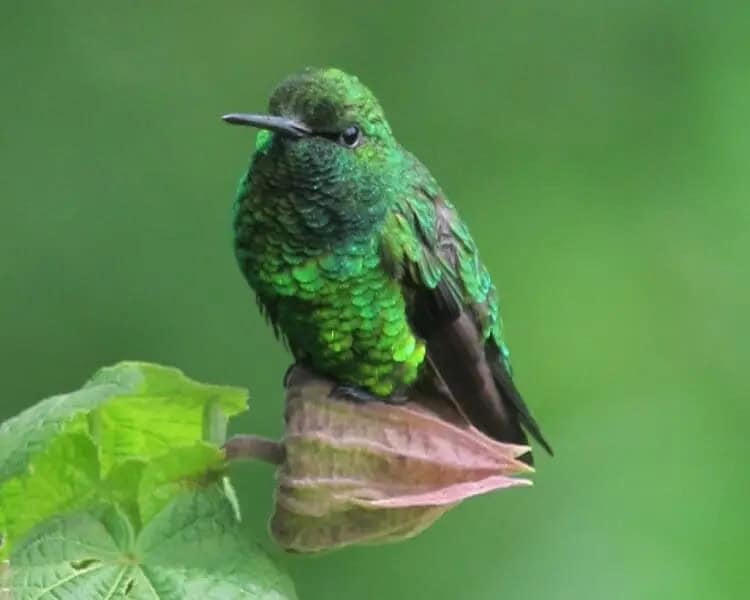
Range: Known scientifically as Chlorostilbon assimilis, this garden emerald belongs to the Trochilini tribe within the hummingbird subfamily Trochilinae. Its habitat is mostly in southwestern Costa Rica, Panama’s Pacific coast, and nearby islands such as Coiba and the Pearl Islands.
Habitat Preferences: The garden emerald thrives in open areas like woodland edges, hedgerows, streamside thickets, scrublands, and gardens, usually within lowland regions. In Costa Rica, they’re found at elevations from sea level up to 1,500 meters (4,900 ft), and in Panama, up to 1,200 meters (3,900 ft).
Diet: Foraging for nectar, the garden emerald follows a “trap-line” pattern, where it visits a variety of flowering trees, shrubs, and plants. It also supplements its diet with small insects found on vegetation.
Breeding Behavior: In Panama, the garden emerald’s breeding season appears to stretch from November to March. While specifics about nesting, incubation, and fledging remain unclear, researchers believe their habits align closely with those of other Chlorostilbon species.
Behavioral Patterns: Generally sedentary, the garden emerald may migrate between mainland Panama and nearby islands, including the Pearl Islands.
Vocalizations: Not much is known about the garden emerald’s calls, but they are believed to resemble those of Canivet’s emerald (Cynanthus canivetii). Canivet’s emerald has a repetitive, wiry song described as “tseee tseeree,” with a dry, scratchy “chut” or “chit” call, occasionally forming a soft, staccato chatter.
Conservation Status: The International Union for Conservation of Nature (IUCN) lists the garden emerald as a species of Least Concern, with an estimated population of over 50,000 mature individuals.
The population appears stable, with no immediate threats identified, and this adaptable species may expand its range as more forests are cleared, favoring man-made habitats.
Read More Birds
